In this post I would like to highlight a relative new (to me) application of MPLS called Unified MPLS.
The goal of Unified MPLS is to separate your network into individual segments of IGP’s in order to keep your core network as simple as possible while still maintaining an end-to-end LSP for regular MPLS applications such as L3 VPN’s.
What we are doing is simply to put Route Reflectors into the forwarding path and changing the next-hop’s along the way, essentially stiching together the final LSP.
Along with that we are using BGP to signal a label value to maintain the LSP from one end of the network to the other without the use of LDP between IGP’s.
Take a look at the topology that we will be using to demonstrate this feature:
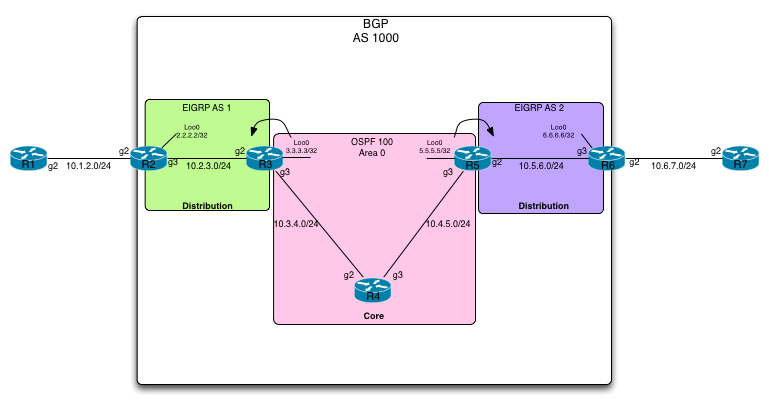
In this topology we have a simplified layout of a service provider. We have a core network consisting of R3, R4 and R5 along with distribution networks on the right and left of the core. R2 and R3 is in the left distribution and R5 and R6 is in the right hand side one.
We have an MPLS L3VPN customer connected consisting of R1 in one site and R7 in another.
As is visisible in the topology, we are running 3 separate IGP’s to make a point about this feature. EIGRP AS 1, OSPF 100 and EIGRP AS 2. However we are only running one autonomous system as seen from BGP, so its a pure iBGP network.
Now in order to make the L3VPN to work, we need to have an end-to-end LSP going from R2 all the way to R6.
Whats is key here is that in order to have end-to-end reachability, we have contained IGP areas, each of which is running LDP for labels. However between the areas, all we are doing is leaking a couple of loopback adresses into the distribution sections from the core. These are used exclusively for the iBGP session.
On top of that, we need to have R3 and R5 being route-reflectors, have them being in the data path as well as having them allocating labels. This is done through the “send-label” command along with modifying the next-hop (“next-hop-self all” command).
This is illustrated in the following:
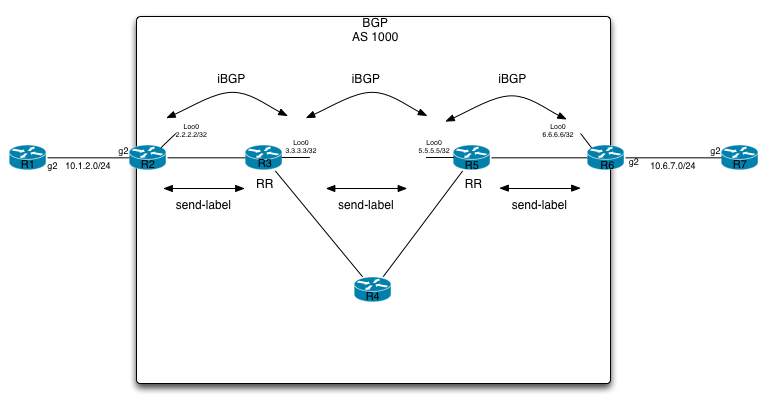
Enough theory, lets take a look at the configuration nessecary to pull this of. Lets start out with R2’s IGP and LDP configuration:
Pretty vanilla configuration of IGP + LDP.
The same for R3:
Apart from the redistribution part, its simply establishing an EIGRP adjacency with R2. On top of that we are redistributing R3’s loopback0 interface, which is in the Core area, into EIGRP. Again, this step is nessecary for the iBGP session establishment.
An almost identical setup is present in the other distribution site, consisting of R5 and R6. Again we redistribute R5’s loopback0 address into the IGP (EIGRP AS 2), so we can have iBGP connectivity, which is our next step.
So lets take a look at the BGP configuration on R2 all the way to R6. Im leaving out the VPNv4 configuration for now, in order to make it more visible what we are trying to accomplish first:
As visible from the configuration. We have 2 IPv4 route-reflectors (R3 and R5), both of which put themselves into the datapath by using the next-hop-self command. On top of that we are allocating labels for all prefixes via BGP as well. Lets verify this on the set:
Since we are only injecting 2 prefixes (loopbacks of R2 and R6) into BGP, thats all we have allocated labels for.
Doing a traceroute from R2 to R6 (between loopbacks), will reveal if we truly have an LSP between them:
This looks exactly like we wanted it to. (note that the 401 label is on a pure P router in the core).
This also means we can setup our VPNv4 configuration on R2 and R6:
Lets verify that the iBGP VPNv4 peering is up and running:
We do have the prefixes and we should also have reachability from R1 to R7 (by way of their individual static default routes):
Looks good, lets check the label path:
What we are seeing here is basically the same path, but with the “VPN” label first (label 600).
So what have we really accomplished here? – Well, lets take a look at the RIB on R2 and look for the IGP (EIGRP AS 1) routes:
A very small table indeed. And if we include whats being learned by BGP:
Only 1 prefix to communicate with the remote distribution site’s PE router (which we need the label for).
This means you can scale your distribution sites to very large sizes, keep your core as effecient as possible and eliminate using areas and whatnot in your IGP’s.
I hope its been useful with this quick walkthrough of unified/seamless MPLS.